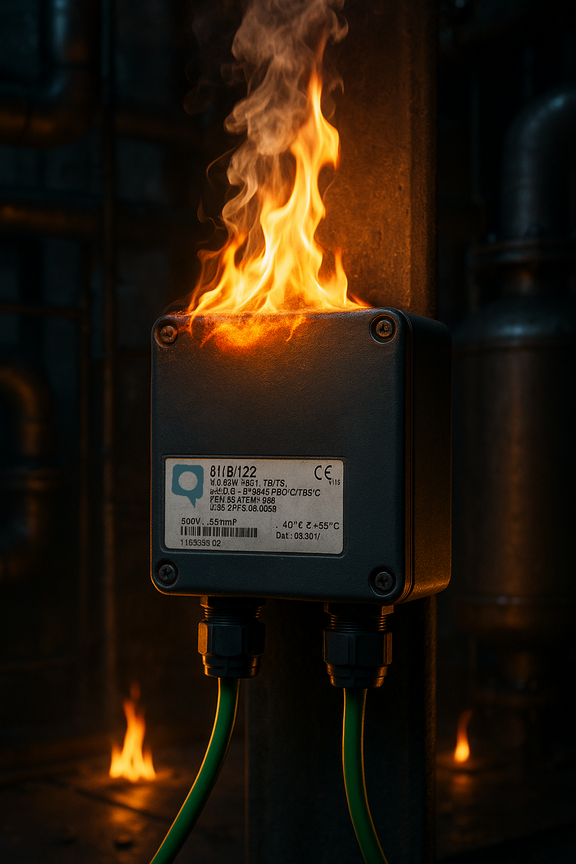
What does fire protection have to do with cables and wires? What do operators and installers of systems need to consider when selecting cables if these are to be permanently installed in buildings? This document is intended to highlight hazards and explain, based on the legal framework, what needs to be considered when selecting suitable cables. It is a supplement or extension to our TB005 brochure “Cables and wires for hazardous areas” and our technical report “Cables and wires for explosion-proof areas” and refers only to the fire behavior of cables.
What is the CPR?
The European Construction Products Regulation (CPR) EU 305/2011 is a legal regulation applicable in the EU. It defines basic safety requirements for buildings. One of these safety requirements is fire protection. The Construction Products Regulation establishes uniform product and testing standards for construction products. Construction products are defined as all goods that are permanently installed in buildings. Since July 1, 2017, the CPR also includes cables and wires that are permanently installed in buildings.
If cables and wires are permanently installed in buildings, the Construction Products Regulation is binding for all EU member states. Cables and wires must undergo special tests in order to determine their behavior in the event of a fire.
The European fire classes for cables according to EN 50575
Cables are subjected to special tests in order to assess the degree of fire hazard they pose. An independent testing and certification institute tests cables and wires for general use in buildings with regard to fire behavior requirements based on EN50575:2014+A1:2016. If the cable meets the applicable limits, it is assigned to a CPR class ranging from Aca (non-combustible) to Fca (highly flammable) based on specific classification criteria. The test results are used to classify the cables into the following fire classes.
Main classes
The following list shows the six main classes and their significance for heat generation during flame spread
- Aca:Non-combustible
- B1ca/B2ca:Very high, flame retardant
- Cca:High, flame retardant
- Dca:Medium, normal flammability
- Eca:Low, normal flammability
- Fca:Highly flammable or no requirement
Incidentally, “ca” stands for cable. A single test of the cable is sufficient up to fire class Dca. If you want to certify a higher fire class (Cca, Bca), the cable must be tested regularly (about once a year).
Additional tested properties
The following classifications can be made:
- Smoke development (s): s1 (low), s2 (medium), s3 (high)
- Burning dripping (d): d0 (no burning dripping), d1 (limited), d2 (no performance detected)
- Acidity (a) (corrosive effect of gases): a1 (low, less corrosive, produce less corrosive gases in case of fire), a2 (medium), a3 (high)
The fire classes are mandatory for cables that are permanently installed in buildings.
Fire class of the cable and building safety
The choice of the right fire rating depends on the fire protection concept and the safety requirements of the building in question.
In Germany, Eca is the minimum requirement, but higher ratings are often recommended.
The fire rating of a cable must meet the safety requirements of the building in question.
Very high safety requirements in the building à Fire class B2ca
High safety requirements in the building à Fire class Cca
Medium safety requirements à Fire class Dca
And low safety requirements à Fire class Eca
| Fire class | Additional criterias | Building - Safety class | ||
| Flame spread / Heat development | Smoke development | Burning Tripping | Acidity | |
| B2ca | s1 | d1 | a1 | Very high |
| Cca | s1 | d1 | a1 | High |
| Dca | s2 | d2 | a1 | Medium |
| Eca | Low | |||
What exactly is being tested/confirmed?
The behavior of cables and insulated wires in the event of fire is tested using general test methods. Heat release and smoke generation are measured during the flame spread test (DIN EN 50399 (VDE 0482-399):2017-02, EN 50399:2011 + A1:2016).
The smoke density of cables and insulated wires when burning under defined conditions (DIN EN 61034-2 (VDE 0482-1034-2):2021-02, EN 61034-2:2005 + A1:2013 + A2:2020) as well as the vertical flame spread on a conductor, an insulated wire, or a cable (e.g., test method with a 1 kW flame with a gas/air mixture) (DIN EN 60332-1-2 (VDE 0482-332-1-2): 2022-07, EN 60332-1-2:2004 + A1:2015 + A11:2016 + A12:2020).
What do the tests indicate?
The VDE Testing and Certification Institute has tested our cable and classified its fire behavior as follows:
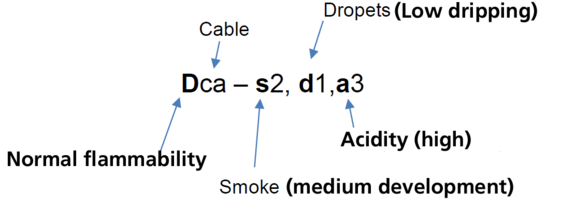
For buildings with higher safety requirements, at least fire class Cca is recommended. Our cables and wires are only classified as class Dca because they are not tested annually. Can they still be used?
Flame resistance
Section 9.3.9 of IEC/EN 60079-14 also defines the requirements for flame propagation of cables in hazardous areas. Our hazardous area cables are flame-retardant in accordance with IEC 60332-1-2 and IEC 60332-2-2. Specifically, this means that the cable is “ignited” with a 1 kW flame and the flame must not spread. Otherwise, an ignitable spark from a fire in the safe area would be transferred to the hazardous area via the cable, which would inevitably lead to an explosion. The standard specifies the options of fire-resistant installation or fire barriers if flame-retardant cables are not available for these applications; fire bulkheads are also frequently used in practice. Where possible, flame-retardant cables should be used in the design. See also Cables for explosion-proof systems.
SAMCON Cables – Overview and possible applications
An overview of our cables and their properties can be found in the following table, among other places.
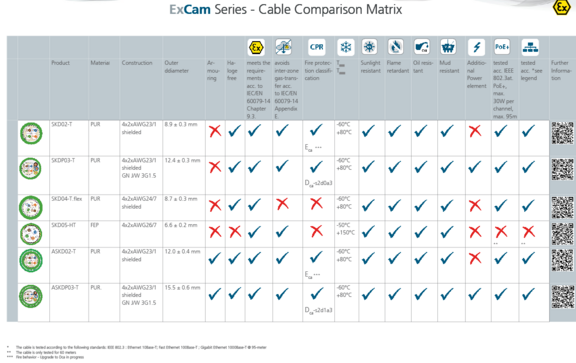
The status (Feb 2026) of fire protection labeling for our cables is as follows:
| Product/Model | Fire behavior |
| SKD02-T | Eca; Upgrade Dca in progress |
| SKDP03-T | Dca – s2, d0, a3 |
| SKD04-T.flex | Flexible cable not suitable for permanent installation |
| SKD05-HT | Not suitable, not halogen-free |
| ASKD02-T | Eca; Upgrade Dca in progress |
| ASKDP03-T | Dca – s2, d1,a3 |
Many of our cables offer the option of upgrading.
Final remark
If you want to install a cable permanently in a building, choose a cable that has been tested in accordance with the safety requirements for your building. This will reduce the risk of fire.