
Safety instructions
Attention
- Absolutely observe the installation's safety directions of the T08 ExCam series
- The camera is not suitable for use in zone 0 and 20!
- Temperature class and explosion group must be absolutely adhered to!
- The specified temperatures have to be observed!
- The customer is not allowed to make any alterations of the camera.
- The camera must be operated in a proper and sound condition and only in the way intended.
- Repairs may only be carried out by using original parts from the manufacturer. Repairs which affect explosion protection may only be carried out in accordance with the nationally applied regulations and exclusively by the manufacturer.
- When installing the ExCam adhere to the requirements of the EN/IEC 60079-14.
Warnings
WARNING:
DO NOT OPEN IN POTENTIALLY EXPLOSIVE ATMOSPHERES
Observe the safety instructions in the installation guide!
--------------------------------------------------------------------------------------------------------
ВНИМАНИЕ:
НЕ ОТКРЫВАТЬ в потенциально взрывоопасных средах
Соблюдайте инструкции по технике безопасности в руководстве по установке!
---------------------------------------------------------------------------------------------------------
AVERTISSEMENT:
NE PAS OUVRIR EN ATMOSPHÈRES EXPLOSIBLES
Respectez les consignes de sécurité dans le guide d'installation!
---------------------------------------------------------------------------------------------------------
AVISO:
NÃO ABRIR DENTRO DE UMA ÁREA COM PERIGO DE EXPLOSÃO
Observar as instruções de segurança nas instruções de instalação!
---------------------------------------------------------------------------------------------------------
Explosion protection
| Identification marks acc. to Directive 2014/34/EU |
Ex II 2G (zone 1 and 2) |
| Ex II 2D (zone 21 and 22) | |
| Ex I M2 (Mining approval only for variants with flip.Connect® or armored cable and plug termination) | |
| Explosion protection (gas) | Ex db IIC T5 Gb |
| Explosion protection (dust) | Ex tb IIIC T95°C Db |
| Explosion protection (mining) | Ex db I Mb |
| Protection level ExCam | IP68 (IEC /EN 60529) |
| Transport/ storage temperature | -40°C…+65°C (non-condensing) |
| Ambient temperature (EX) | -40°C…+60°C (Type...L.H) |
| -60°C…+60°C (Type...LL.H) | |
| Named testing laboratory | TÜV Rheinland (number 0035) |
| EU type approval certificate | TÜV 18 ATEX 8218X (2018) |
| IECEx Cert. of Conformity | TUR 18.0023X (2018) |
| INMETRO-Certificate | TÜV 23.0363X (2023) |
| EAC-Ex TUR Report | TC RU C-DE.HA65.B.01652/22 |
Model variants
| Ex product name | Model variants | Article no. | |||||
|---|---|---|---|---|---|---|---|
| 1) | 2) Type
| 3) Housing (combination)
| 4) Temp. range | 5) Cable length [m] cable type | 6) Termination | Link to digital type plate | |
| ExCam IPP1488 | T08- | VA2.2.K4.BOR3- | L.H- | 005.N- | P | 22070651 | |
| T08- | VA2.2.K4.BOR3- | L.H- | 005.N- | T | 22070652 | ||
| T08- | VA2.2.K4.BOR3- | L.H- | 005.A- | P | 22070653 | ||
| T08- | VA2.2.K4.BOR3- | L.H- | 005.A- | T | 22070654 | ||
| T08- | VA2.2.K4.BOR3- | L.H- | 005.X- | X | 22070650 | ||
| T08- | VA2.2.K4.BOR3- | LL.H- | 005.N- | P | 22070646 | ||
| T08- | VA2.2.K4.BOR3- | LL.H- | 005.N- | T | 22070647 | ||
| T08- | VA2.2.K4.BOR3- | LL.H- | 005.A- | P | 22070648 | ||
| T08- | VA2.2.K4.BOR3- | LL.H- | 005.A- | T | 22070649 | ||
| T08- | VA2.2.K4.BOR3- | LL.H- | 005.X- | X | 22070645 | ||
Description:
- ExCam IPP1488 = Functional camera description of the ExCam Series (technical data/ specification of the individual camera module)
- T08 = SAMCON Production- type 08 (ex-proof camera)
- VA2.X.KX.BOR = housing (stainless steel 1.4404) with large diameter ØVA2=113mm)
VA2.2.KX.BOR = T07 VA2.2 housing with medium body lenght (LR = 261mm)
VA2.2.K4.BORX = K4 flipConnect and flange
VA2.X.KX.BOR3 = Borosilicate sight glass DIN7080 (standard, for video cameras within visible spectral range: λ = 350...2000 [nm] and fotografic infrared range NIR, not suitable for thermografic applications (MIR/ FIR), for cameras without wiper
L.H = High temperature battery installed (Tamb < +50°C)
L.H = low temperatures (Tamb ≥ -30°C)
LL.H = PTC-heater installed (Tamb ≥ -45°C) - 005.X = Length of the connection line in meter at delivery; 5m is the standard cable length, max. cable length is: 005...100 [m]
005.N = Non armoured cable
005.A = Armoured cable
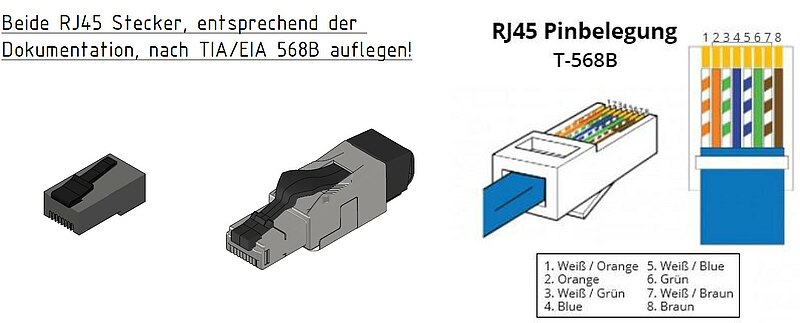
000.X = without connection cable - P = Plug- termination (standard) CAT6, RJ-45 network plug (heavy duty), AWG 26-22, contact assignment acc. to specification EIA/TIA-568B
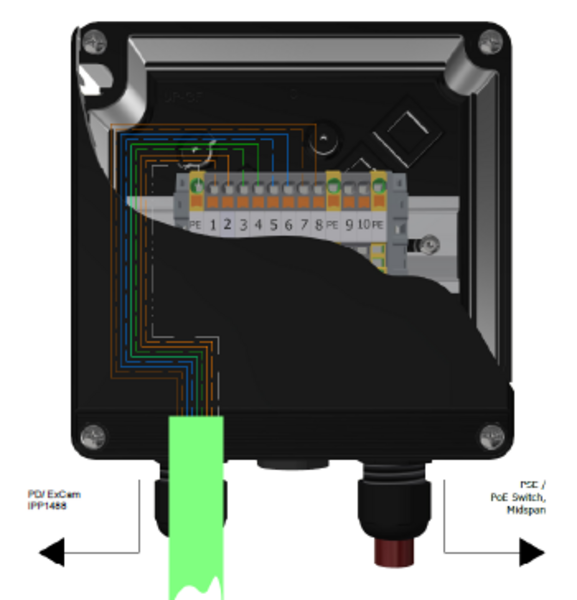
T = Terminal box- termination (optional) 4 x PoE Mode A connection (camera PoE) (see electrical connection)
X = Connection via flipConnect
Electrical parameters
Power supply of the camera, no heater:
Voltage supply: PoE, IEEE 802.3af/802.3at, class 3
Typical power consumption: 8.0 W
Maximum power consumption: 12.95 W
Power supply of the camera with heater:
Voltage supply: PoE++, IEEE 802.3bt, class 7
Typical power consumption: 45.0 W
Maximum power consumption: 60.0 W
System cables for devices with flipConnect
Devices with flipConnect are delivererd without a cable tail and without a cable gland, only with non - Ex blind plug (nylon PA3200, red) for mounting a suitable explosion proof cable kit. Quicklink for suitable cables and cable glands:
flipConnect-Compatibility
Connection cables
Appropriate cables & cable glands:
for this watch the following video-tutorial or the informations on the cable-page.
Cable glands
System cable SKD02-T --> Gland Capri ADE1F2 Cap No.5
System cable ASKD02-T --> Gland Capri ADE4F Cap No.6
Declaration of conformity, Instruction Manual
Other technical data
Permissible ambient temperature: -40°C ... +60°C/-60°C ... +60°C (models ...-LL.H-...)
Protection class as per EN 60529/IEC 529: IP68 (test conditions 24h/3m water column at 5°C)
Housing material: Stainless steel mat. no.: 1.4404
Weight: ca. 7kg
Dimensions: T07 VA2.1 D113mm x 261mm
Mounting
- Check device for transport damage on housing and cable.
- Carefully choose installation site (lightning conditions, object distance,...)
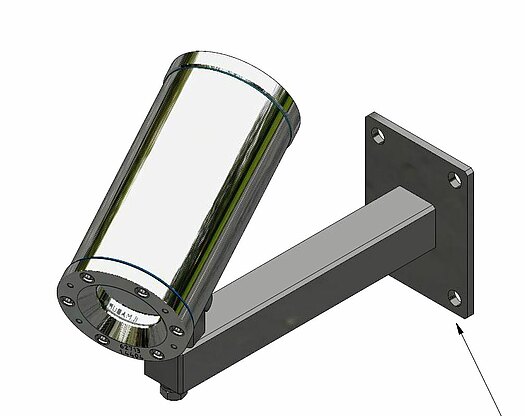
- Optional mounting accessories for easy fixation on Pole, Wall or Hinge.
- Depending on classification of hazard areas, a work approval has to be obtained.
Prevent potentially explosive atmosphere, when opening the pressure-resistant enclosure under voltage! - National security, installation and accident prevention regulations (e.g. DIN EN 60079-14), safety instructions in this User Manual, as well as the ones in the Installation Guidelines have to be observed!
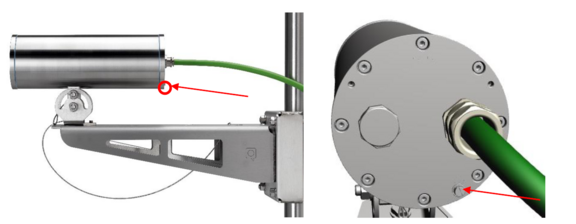
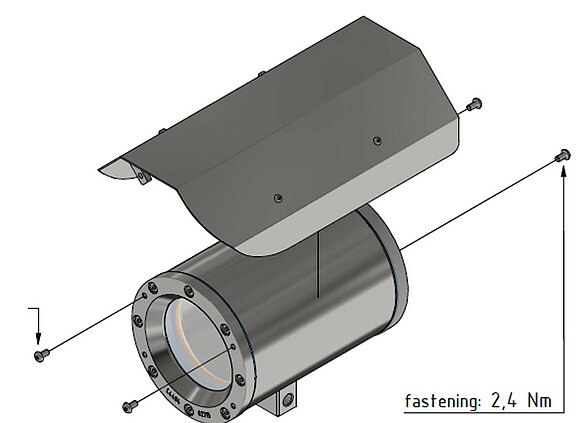
- Always mount the camera using the appropriate screws and hexagon nuts (1 screw conforming to DIN 6921 M8-A4-70 or ISO 4017 M8-A4-70/ DIN 933 M8-A4-70 and hex nut DIN 4032 M8-A4-70) and the appropriate torque.
Alternatively: 4 pan-head screws ISO 7380-2 M6x8-A4-70-TX30.
Tests prior to switching on voltage
Attention!
- Prior to starting the device, perform all tests as indicated by the national regulations. Furthermore, check the correct function and installation of the device in accordance with this User Manual and other applicable regulations.
- Incorrect installation or operation of the camera may lead to a loss of warranty!
- Do not switch on the camera at temperatures below 0°C!
Opening the camera housing
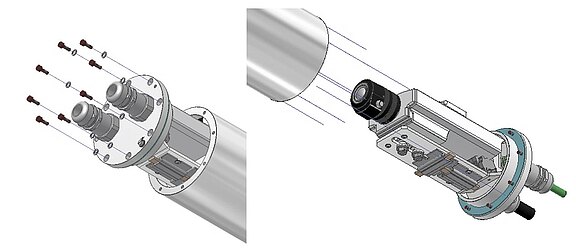
Loosen the eight screws on the rear side of the cable and power supply flange. Never open the front-side sight-glass flange.
Carefully pull out the cable and supply flange to the rear, as straight as possible. Because of negative pressure, it may be difficult to remove the flange. The cylindrical clearance fit (H8f7 - DIN ISO 286) of the camera body and flange may not be tilted! Risk of damage to the flame-proof gap (DIN EN 60079-1:2012)!
Attention!
The mounting adapter with the housing’s PTC heater, camera module and optics, as well as the temperature control, and (if applicable) auxiliary relays and terminal block are fixed on the cable and supply flange. Dealing with these components, too, you have to work very carefully and precisely in order to avoid canting and damage to the in-built components! Caution: do not touch the cylindrical fit surface with your skin or clothes! On the surface, there is oil lubricating paste to protect the surface against fretting corrosion and mechanical stresses. When you open the housing, pay attention that you do not damage the GYLON® flat seal (blue, RAL5012) and do not make it dirty! The flat gasket is loosely attached to the cable and power supply flange. It is fixed only by the bolted connections!
Removing / inserting a SD memory card
The ExCam IPP1488 has a slot for a micro SDHC memory card (card not included). Saved video files can be played and deleted via the web interface. They are also available in a download list. Moreover, the videos available in the memory card can also be accessed via FTP server in the network.If the memory card has to be replaced by the user, it should be, as far as possible, empty and pre-formatted with an ext4 or vFAT file system.
When touching electrical components, observe potential equalization (grounding of the body): carry electrostatic-discharge clothes, a PE wristband etc.!
Hardware Reset
To set all the parameters of the ExCam IPP1488 (including the IP address) to default values, you should run a hardware reset. The parameters can be reset via the web interface or manually. If the camera placed in the network can no longer be reached or its state is uncontrollable, the reset should be per-formed manually. To do so, proceed as follows:
- Disconnect the camera installation module (Axis P1488-LE) from the power supply.
- Press and hold the control button (see the illustration below) and, at the same time, connect the system to the voltage supply (PoE).
- Hold the control button pressed for about 30 seconds.
- Release the control button. After about a minute, the AXIS P1488-LE will return to factory defaults. If there is a DHCP server in the network, the IP address will be the following: 192.168.0.90 (subnet masking 255.255.255.0).
- IP address and password can be redefined. If the hardware reset is not satisfactory or the network camera shows serious conflicts or does not work as usual (errors in the browser visualisation, frozen images, control commands no longer processed, slowing down of the system, etc.), it may be necessary to re-install the current firm-ware, or to install an update.
Closing of the pressure-resistant housings
For closing the housing, proceed in reverse order as when opening. Use exclusively original screws included in the supply. The cable and power-supply flange (K1) is fixed by 8 cylinder-head screws M4*0.7 (ISO metric right-turning) with 12 mm thread length (DIN 912/ ISO 4762, grade 6g). Materials of bolted connections are identical to the pressure-resistant stainless steel housing (standard material no. 1.4404 AISI316L). Check whether the threaded holes are undamaged and clean. Before closing, it is also absolutely imperative to check the flame-proof gap (circular cylindrical fit).
Attention!
If any mechanical damages occurred to the fitting gap, it is no longer allowed to use the housing!
Attention!
Do not lock-in any foreign objects in the housing.
Attention!
Insert the flange to reach the end position, in order to ensure ignition protection and the protection level (IP) of the housing.
Dismantled screw locks (spring washers DIN 127A) must be used again. The GYLON® gasket must be used in undamaged condition, according to the flange hole pattern, and placed between the flange and the hull. The lateral position of the flat surface / contact surface is arbitrary. If, when closing the housing, you see that the surface of the fitting gap is dirty or insufficiently lubricated, clean it with a clean cloth and de-grease it with a suitable cleaning agent. Then re-grease it with lubricant suitable for this specific application (e.g., Molykote® P-40 gel for standard applications or special grease OKS 403 in the event of heavy seawater influence).
Closing of the camera housing
Cylinder-head bolts for explosion-proof connection of the camera body with the flange component must always be tightened at a 3 Nm torque - crosswise and evenly! Use Loctite.
Closing of the luminaire housing
Cylinder-head bolts for explosion-proof connection of the luminaire body with the flange component must always be tightened at a 1.2 Nm torque - crosswise and evenly! Use Loctite.
Initial start-up
https://help.axis.com/en-us/axis-p1488-le
Applicable net frequency: 50Hz or 60Hz
Carry out other net frequency: menu System Options > Advanced > Plain Config
User: root
Password: root
Browser support
A list of the currently supported web browsers, operating systems, required add-ons, etc. can be viewed at:
https://help.axis.com/access-your-device
https://www.axis.com/support
Allocating IP Adress
The ExCam IPP1488 is intended for use in an Ethernet network and requires an IP address to access and control it. In the most today's networks, a DHCP server is integrated. This server automatically assigns an IP address. If there is no DHCP server available in the network, the IP default address of ExCam IPP1488 is "192.168.0.90" (subnet masking 255.255.255.0). With the "AXIS IP Utility", it is possible to determine the IP address under Windows; the included USB stick contains this application.
https://www.axis.com/support/tools/axis-ip-utility
If it is not possible to assign the IP address, it might be necessary to change the firewall settings! The "AXIS IP Utility" tool automatically recognizes all ExCam devices and visualises them in the device list. It can also be used to manually assign a static IP address. For this purpose, the ExCam IPP1488 network camera has to be installed in the same physical network segment (physical subnet) as the computer on which the AXIS IP Utility is running. The network signature of ExCam IPP1488 is "AXIS P1488-LE". MAC address and serial number for clear device identification are also detected and displayed.


Questions about our products
If you have any questions about our products please contact our Sales Team.